01The Default Setting is a Hidden Tax
When a team spins up a new project, the path of least resistance is almost always to create an S3 bucket and use the 'Standard' storage class. It works immediately, offers high durability, and is available whenever you need it. Because of this, it becomes the default. Over months, and eventually years, that bucket becomes a black hole of data. You accumulate raw logs, binary blobs, and legacy backups that nobody touches but everyone continues to pay for at a premium price.
Storing everything in S3 Standard is a common form of cloud governance neglect. It is not just about the storage costs; it is about the operational debt created by ignoring the lifecycle of your data. If you are not actively moving data that isn't being accessed into cheaper storage tiers, you are paying a 'laziness tax' on every single byte you store.
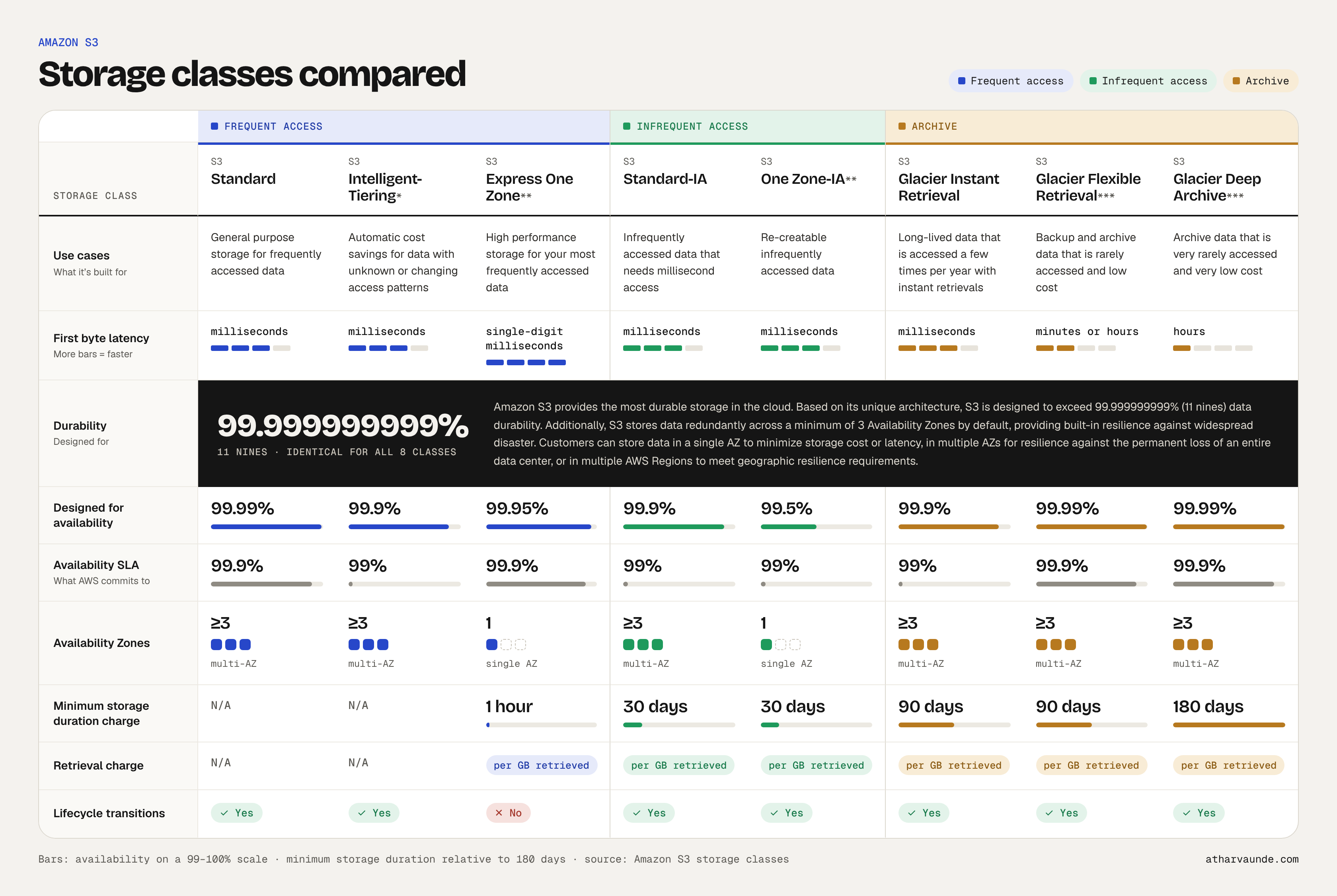
02Understanding the S3 Storage Spectrum
AWS provides a range of storage classes, each optimized for different access frequencies and durability requirements. The critical realization is that durability remains consistent across most classes, while the price, retrieval latency, and availability SLAs change drastically. You are often paying for performance you are not actually utilizing.
Comparing the Classes
| Storage Class | Availability SLA | Min. Duration | Retrieval Cost | Best For |
|---|---|---|---|---|
| Standard | 99.99% | None | None | Frequently accessed data |
| Intelligent-Tiering | 99.9% | None | None | Data with changing access patterns |
| Standard-IA | 99.9% | 30 Days | Medium | Infrequently accessed, needs retrieval |
| One Zone-IA | 99.5% | 30 Days | Medium | Reproducible, secondary data |
| Glacier Instant Retrieval | 99.9% | 90 Days | Medium | Rarely accessed, needs ms-latency |
| Glacier Flexible Retrieval | 99.9% | 90 Days | High | Archive data, retrieval 1 min - 12 hours |
| Glacier Deep Archive | 99.9% | 180 Days | Highest | Long-term compliance (months) |
03Why S3 Standard is Often the Wrong Default
Standard is optimized for data that requires immediate, frequent access. It is the most expensive class per gigabyte, but it carries no minimum storage duration and no retrieval fees. This is perfect for your active web assets, but it is entirely inappropriate for your application logs from three months ago.
The Failure Modes of 'Standard' Abuse:
- Archive Accumulation: Treating the bucket like a permanent home for backups where the data is written once and never read.
- The Accessibility Fallacy: Holding onto data in the Standard tier 'just in case' because of a fear that cheaper classes will be too slow, despite most of that data never being requested again.
- Lifecycle Neglect: Allowing data to sit in an expensive tier because no automated policy was defined to transition or delete the objects.
04The Case for Intelligent-Tiering
If you are unsure of your access patterns, S3 Intelligent-Tiering is the most effective tool in your belt. It automatically monitors the access patterns of your objects and shifts them between four tiers: Frequent, Infrequent, Archive Instant, and Deep Archive. You pay a small monitoring fee per object, but you gain the peace of mind that your data will always reside in the most cost-effective tier. It effectively eliminates the need to manually guess which data is 'hot' or 'cold.'
05Embracing the Glacier Revolution
Historically, Glacier was synonymous with long wait times, leading engineers to avoid it. The modern Glacier classes, specifically 'Instant Retrieval,' allow for millisecond latency while maintaining archive-tier pricing. You can now store data that you rarely need but require instantly upon request without paying for Standard tier rates. The primary constraint is the minimum storage duration; if you delete or overwrite objects too early, you will be hit with a prorated charge for the remaining duration.
06What I Actually Do
In my experience, managing storage should be as automated as managing code. I treat S3 buckets as living entities that require a strict lifecycle policy. If I see a bucket without a lifecycle configuration, I treat it as an incomplete deployment.
My Standard Playbook for Storage Governance:
- Default to Intelligent-Tiering: For all new application buckets, I set Intelligent-Tiering as the default class. It is the safest way to prevent runaway costs while you figure out how your application actually uses the storage.
- The 90-Day Purge for Logs: For application and system logs, I implement a policy to move them to Standard-IA after 30 days and delete them entirely after 90 days. If logs are still valuable after 90 days, they should be in a centralized log management platform, not in raw S3 storage.
- Glacier for Compliance: Any data required for financial audits or legal compliance is automatically moved to Glacier Deep Archive upon creation using a lifecycle rule.
- One Zone-IA for Re-creatable Data: If I have raw media uploads that are used to generate thumbnails, the original source is stored in Standard, but the resulting processed files are stored in One Zone-IA.
07Closing / TL;DR
Stop treating S3 Standard as your only storage option. By leveraging Intelligent-Tiering for unknown patterns, Glacier for archiving, and automated lifecycle policies for maintenance, you can reduce your storage footprint and simplify your cloud overhead. Treat your storage class selection as an architectural decision, not a configuration afterthought.